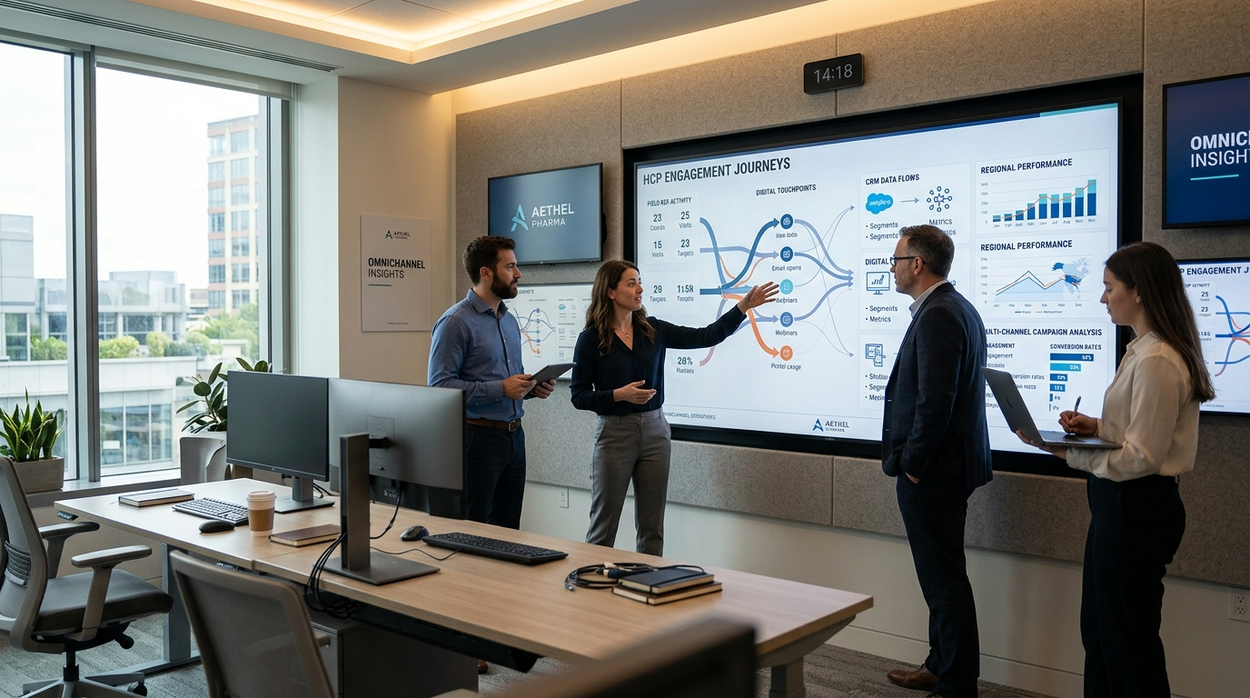
The Shift to Omnichannel Orchestration in Commercial Pharma Strategies
Pharmaceutical commercial engagement has traditionally operated through separate channels: field representatives made calls, marketing teams sent emails, digital teams ran campaigns, and brands hosted webinars or events. Each activity could be effective on its own, but the overall experience was often fragmented. For time-constrained healthcare professionals (HCPs), repeated or poorly timed messages can create noise rather than relevance.
Omnichannel orchestration in pharma represents a shift from simply adding channels to coordinating them intelligently. Instead of treating every interaction as an isolated campaign, commercial teams can use unified data, behavioral signals, analytics, and AI to determine what message should be delivered, through which channel, and when.
The strategic question is therefore no longer how many channels a pharma company uses. It is whether those channels work together as a connected journey. Modern commercial models increasingly aim to make HCP engagement continuous, relevant, measurable, and responsive to changing preferences.
The Anatomy of Orchestration: From Static Segmentation to Real-Time AI
Traditional segmentation typically relies on relatively stable characteristics such as specialty, geography, prescribing volume, institution, or historical sales potential. These variables remain useful, but they provide only a partial picture of how an individual HCP wants to engage.
A more advanced commercial pharma omnichannel strategy creates a dynamic customer profile by combining CRM information with consented digital engagement, previous interactions, content interests, channel preferences, and other relevant signals. The result is less like a fixed target list and more like a continuously updated behavioral profile.
This distinction matters because HCP preferences and engagement patterns can change. Industry analysis has highlighted the limitations of static target lists and the potential of dynamic segmentation and AI/ML to adjust engagement priorities as new signals emerge.
Next-Best-Action Engines
The next layer is the AI next best action pharma marketing model. Rather than asking marketers to manually determine the next communication for every segment, machine-learning systems can evaluate multiple signals and recommend an appropriate action.
A recommendation might involve:
- Scheduling a field interaction after meaningful digital engagement
- Offering scientific content through a preferred channel
- Adjusting communication frequency
- Following up on a previous interaction
- Holding further outreach when additional communication is unlikely to add value
Modern NBA systems can combine rules-based logic with machine learning and customer-level behavioral information to recommend the customer, message, channel, and timing of an interaction.
Unified Work Graphs
Orchestration ultimately requires a connected operational view. Products, HCP segments, content, field activity, digital engagement, and outcomes need to be represented as related elements rather than disconnected campaign records.
This creates a closed feedback loop: an engagement generates data, that data changes the customer profile, the updated profile informs the next action, and the outcome feeds the next iteration. AI can assist this process, but its usefulness depends heavily on the quality, governance, and accessibility of the underlying data.
Bridging Commercial and Medical Affairs Strategies
Omnichannel transformation can create another problem if commercial and medical affairs teams build separate engagement systems around the same HCP audience.
A physician could receive a promotional email from marketing, a scientific communication from a medical science liaison (MSL), an invitation to a webinar, and a field visit request without those interactions being coordinated. Even when every communication is individually appropriate, the combined experience can feel disjointed.
The solution is not to make medical affairs an extension of commercial marketing. Their objectives, responsibilities, and engagement boundaries remain distinct. Instead, organizations need cross-functional visibility and governance so that appropriate activities can coexist without creating unnecessary duplication or conflicting experiences.
Integrated calendars can help teams understand when major scientific meetings, educational programs, brand campaigns, field initiatives, and other engagements are scheduled. Cross-functional planning can also identify opportunities where a medical interaction should remain independent rather than being followed by inappropriate promotional activity.
Data sharing requires similarly clear boundaries. Organizations should define what information can be accessed, by whom, for which purpose, and under what compliance controls. In the United States, FDA oversight emphasizes that prescription-drug promotional communications must be truthful, balanced, and accurately communicated.
Disease-awareness communication also requires careful distinction from product promotion. FDA materials define disease-awareness communications as communications about a disease or condition that do not mention or make representations about a particular drug or device.
The objective, therefore, is coordination without inappropriate blending of roles.
Hybrid Sales Force Models and Field Rep Evolution
The rise of omnichannel engagement does not eliminate the pharmaceutical sales representative. Instead, the representative’s role is becoming more connected to digital and analytical systems.
A hybrid sales model can combine face-to-face meetings with video calls, digital detailing, email follow-ups, educational resources, and other approved engagement formats. The field representative becomes one component of a broader HCP journey rather than the sole delivery mechanism.
Before a meeting, an orchestration platform can potentially surface relevant information about recent interactions, content engagement, outstanding follow-ups, and channel preferences. During and after the interaction, field feedback can be captured and used to update the HCP profile.
This creates a two-way relationship between field and digital activity. McKinsey has described similar models in which analytics and recommendation engines support engagement planning, while IQVIA’s current field-force tools illustrate how CRM activity, call notes, and other data can be combined into a unified customer view.
The technology should support the representative’s judgment, not replace the human relationship. For complex clinical discussions, trust, scientific understanding, and the ability to respond appropriately to an HCP’s questions remain essential.
Pre-Approval Omnichannel Planning for Launch Success
For emerging biopharma companies, omnichannel planning should not begin when regulatory approval arrives.
Waiting until launch to establish digital infrastructure, audience understanding, educational content, and engagement capabilities creates a compressed commercial timeline. By contrast, pre-approval planning can establish the systems and market understanding needed for launch execution while respecting applicable regulatory requirements.
Early preparation can include disease education, HCP audience mapping, digital channel analysis, scientific content planning, and identification of relevant KOL networks. The purpose is not to prematurely promote an unapproved product. It is to understand the disease ecosystem and prepare appropriate, compliant engagement capabilities.
This distinction is particularly important for specialty and rare-disease launches, where the addressable HCP population may be relatively concentrated and the clinical pathway more complex. McKinsey’s analysis of first-time biotech launchers highlights data-driven precision, microsegmentation, and next-best-action approaches as tools that can help smaller organizations allocate commercial resources more selectively.
Pre-approval planning should therefore focus on market readiness rather than premature product promotion. Disease education, scientific communication, stakeholder mapping, technology infrastructure, content operations, and measurement frameworks can be developed well before commercial launch, subject to applicable jurisdictional requirements.
Practical Checklist for Commercial Operations Leaders
Commercial leaders assessing omnichannel maturity can start with four operational questions.
1. Data Architecture Audit
Is HCP information genuinely connected across CRM, email, websites, events, marketing platforms, and field systems? If teams still reconcile spreadsheets or manually transfer customer information between platforms, orchestration will remain limited.
2. Journey-Level Metrics
Are dashboards measuring the progression of an HCP relationship rather than isolated channel activity?
Email opens, clicks, webinar registrations, and impressions can provide useful diagnostic information, but they should not become the final measure of commercial effectiveness. Teams should increasingly examine engagement sequences, progression between stages, response quality, and appropriate business outcomes.
3. AI Integration
Is AI actually embedded into workflows?
A sophisticated model that produces recommendations nobody uses creates little operational value. NBA recommendations need to reach marketers and field teams inside the systems where decisions are made.
4. Cross-Functional Governance
Do commercial, medical, regulatory, legal, data, and technology teams have defined responsibilities and shared operating processes?
Successful orchestration requires governance alongside technology. Industry experience consistently points to the importance of cross-functional implementation, centralized visibility, and clearly defined guardrails.
Framework for Benchmarking Omnichannel Maturity: An Example Matrix
Organizations can turn these questions into a weighted maturity framework. One practical example is:
| Capability | Suggested Weight |
| Data Integration & Unified Customer View | 25% |
| AI & Next-Best-Action Orchestration | 20% |
| Commercial & Medical Cross-Functional Alignment | 20% |
| Field Rep Hybrid Enablement & Adoption | 20% |
| Journey-Level Outcome Measurement | 15% |
The purpose of the matrix is not to create a universal industry score. It provides leadership teams with a structured way to identify capability gaps and prioritize investment.
For an established primary-care portfolio, data integration, scalable segmentation, and high-volume channel coordination may deserve particular attention. A specialty or rare-disease launch could place greater operational emphasis on scientific engagement, focused HCP identification, field enablement, and pre-launch market preparation.
The weighting can therefore change according to the product, therapeutic area, market, launch stage, and existing commercial model.
Most importantly, maturity should be assessed through operational evidence. A company should be able to demonstrate that data changes decisions, recommendations reach users, teams act on those recommendations, and outcomes feed back into subsequent engagement planning.
Industry Red Flags and Strategic Blind Spots
Several warning signs indicate that a company may be adding channels without achieving true orchestration.
Channel proliferation without coordination is one of the most common. Adding another social platform, email program, webinar series, or digital application does not automatically create an omnichannel experience. The critical question is whether those channels are connected to a coherent HCP journey.
Isolated channel metrics can create another blind spot. Optimizing email engagement while ignoring subsequent field activity or broader HCP progression can encourage local improvements that do not translate into meaningful journey-level outcomes.
Poor-quality HCP data presents an even deeper problem. AI cannot reliably produce useful recommendations from incomplete, duplicated, outdated, or incorrectly structured customer information. Data governance is therefore a prerequisite for sophisticated orchestration, not an optional technical project.
Finally, delaying digital preparation until commercial launch can leave emerging brands trying to build audience understanding, content infrastructure, analytics, and field enablement simultaneously. A more deliberate pre-launch approach gives teams time to establish the operating foundation before commercial demand accelerates.
The central lesson is straightforward: sophisticated technology cannot compensate for disconnected processes or unreliable data.
Final Thoughts — Orchestrating Relevance in Modern Pharma
The move from multichannel activity to omnichannel orchestration in pharma is fundamentally a shift in how commercial organizations think about HCP engagement.
The distinction between multichannel vs omnichannel pharma is not simply the number of available communication channels. Multichannel strategies can operate independently; orchestration connects those interactions into a coordinated journey informed by data, context, and appropriate business rules.
AI, unified customer data, hybrid field models, and cross-functional governance are becoming important components of this transition. But technology alone will not create better engagement. Long-term brand value depends on whether organizations can make every interaction more relevant, respectful, scientifically responsible, and connected to the broader HCP journey.
The emerging commercial model is therefore less about creating more noise and more about orchestrating relevance.