AI-Driven Drug Discovery: Current Successes and Limitations
Drug discovery has always been a high-risk process. Identifying a promising biological target, finding a molecule that can influence it, optimizing that molecule for safety and pharmacokinetics, and then demonstrating clinical benefit can take many years. Most candidates fail somewhere along the way, making pharmaceutical R&D expensive and resource-intensive.
AI-driven drug discovery is changing how some of these decisions are made. Machine learning, deep learning, generative models, and AI-enabled structural biology can analyze biological and chemical datasets at a scale that traditional workflows cannot easily match. The result is faster hypothesis generation, broader virtual screening, and increasingly sophisticated molecular design.
Yet AI has not eliminated the fundamental uncertainty of biology. Landmark advances such as AlphaFold have transformed structural prediction, while generative models have produced experimentally validated molecules. At the same time, data quality, model generalization, wet-lab validation, intellectual property, and regulatory expectations remain significant constraints. The current opportunity is therefore less about replacing scientists and more about improving the quality and speed of decisions across the drug discovery pipeline.
Current Successes: Where AI Is Delivering Measurable Value
AI is already contributing practical value at several points between target identification and clinical development. Its strongest applications tend to be those where large datasets, pattern recognition, and iterative prediction can complement established scientific workflows.
Protein Structure Prediction and Target Identification
Protein structure prediction represents one of the clearest achievements of AI in pharmaceutical research. AlphaFold and related systems have made high-quality structural predictions available for proteins that previously lacked experimentally determined structures. The AlphaFold database now provides access to more than 200 million predicted protein structures, substantially expanding the structural information available to researchers.
These predictions can support target assessment, structural analysis, virtual screening, and hypothesis generation. Newer systems, including AlphaFold 3, extend the approach toward predicting interactions involving proteins and other biomolecules.
However, predicted structures should not automatically be treated as experimental substitutes. Research published in Nature Methods found that even high-confidence AlphaFold predictions can differ from experimental structures, particularly where ligand binding, conformational flexibility, environmental conditions, or other molecular factors matter.
De Novo Molecular Design and Property Optimization
Generative AI is also expanding the way medicinal chemists explore chemical space. Instead of evaluating only molecules already present in a database, generative models can propose new structures according to desired properties such as predicted activity, selectivity, synthesizability, or ADME characteristics.
There is growing evidence that this can move beyond theoretical demonstrations. A 2024 Nature Communications study used deep learning for prospective de novo design and experimentally identified potent PPARγ partial agonists with desired selectivity profiles.
Another study used a generative system to explore a chemical space of nearly 30 billion molecules for antibiotic discovery. Researchers synthesized 58 generated compounds and identified six structurally novel molecules with antibacterial activity.
These results illustrate an important strength of AI: it can prioritize experimentally testable candidates from extremely large search spaces.
Clinical Trial Patient Stratification and Biomarkers
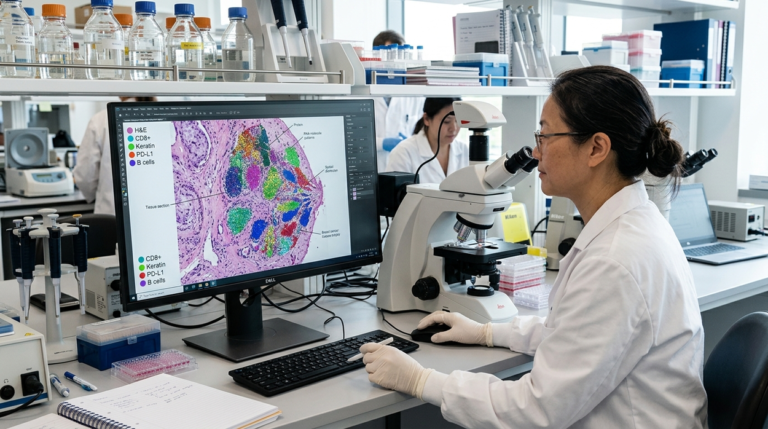
AI is also being applied beyond molecule discovery. Machine learning can analyze genomic, clinical, imaging, and electronic health-record data to identify patient characteristics associated with treatment response or trial eligibility.
Omics-based machine learning has been investigated for biomarker discovery and patient stratification, with the goal of identifying populations more likely to respond to a therapy and reducing unnecessary exposure to ineffective treatments.
In clinical development, AI-assisted patient identification can also improve feasibility and recruitment by matching complex eligibility criteria against large patient datasets. Recent literature describes applications involving electronic health records, clinical registries, and automated prescreening.
The measurable benefit is therefore not necessarily that AI makes a drug “discover itself,” but that it can help research teams make better decisions about which targets, molecules, and patients deserve further investigation.
Critical Limitations and Bottlenecks in AI Drug Discovery
The most important limitations of AI-driven drug discovery are not simply computational. They arise from the complexity and incompleteness of biological data.
Data Quality, Bias, and “Garbage In, Garbage Out”
Machine learning systems depend heavily on the quality and representativeness of their training data. Drug discovery datasets frequently contain inconsistent assay conditions, missing measurements, imbalanced activity classes, duplicated compounds, historical biases, and incomplete reporting of failed experiments.
Negative results are particularly important. If a model mainly sees successful experiments or published findings, it can develop an overly optimistic view of what works. Reviews of AI adoption in drug discovery have highlighted problems including bias, inconsistency, skewed datasets, small sample sizes, and unrealistic benchmarking.
This means that simply adding more data does not necessarily produce a better model. Data provenance, standardization, experimental context, and quality control can be as important as dataset size.
The Generalization Problem and Chemical Space Limits
A model can perform exceptionally well on a benchmark and still struggle when presented with chemistry or biology that differs substantially from its training distribution.
Known chemical libraries provide valuable training material, but drug discovery frequently requires researchers to investigate molecules with unusual structures or targets for which limited experimental data exists. Reviews of AI-based drug discovery have identified data scarcity and limited molecular diversity as persistent challenges.
Generative models also face a practical tension: producing a molecule that looks chemically plausible is easier than producing one that simultaneously has the desired potency, selectivity, ADME profile, toxicity characteristics, stability, and synthetic accessibility.
Wet-Lab Validation and Translational Failure
Computational predictions ultimately need experimental confirmation. A molecule with an attractive predicted binding score may fail because it cannot be synthesized efficiently, behaves differently in a cellular environment, shows unexpected off-target activity, or has unacceptable pharmacokinetics or toxicity.
This is why prospective validation matters more than retrospective benchmark performance. AI models can identify promising hypotheses, but laboratory experiments determine whether those hypotheses survive contact with biological reality.
The same principle applies to structural prediction. AlphaFold has dramatically improved access to structural hypotheses, but experimental work remains important for validating molecular details relevant to therapeutic development.
Navigating the Integration of AI and Wet-Lab Infrastructure
The next stage of AI-driven drug discovery is increasingly focused on connecting computation with experimentation rather than operating them as separate activities.
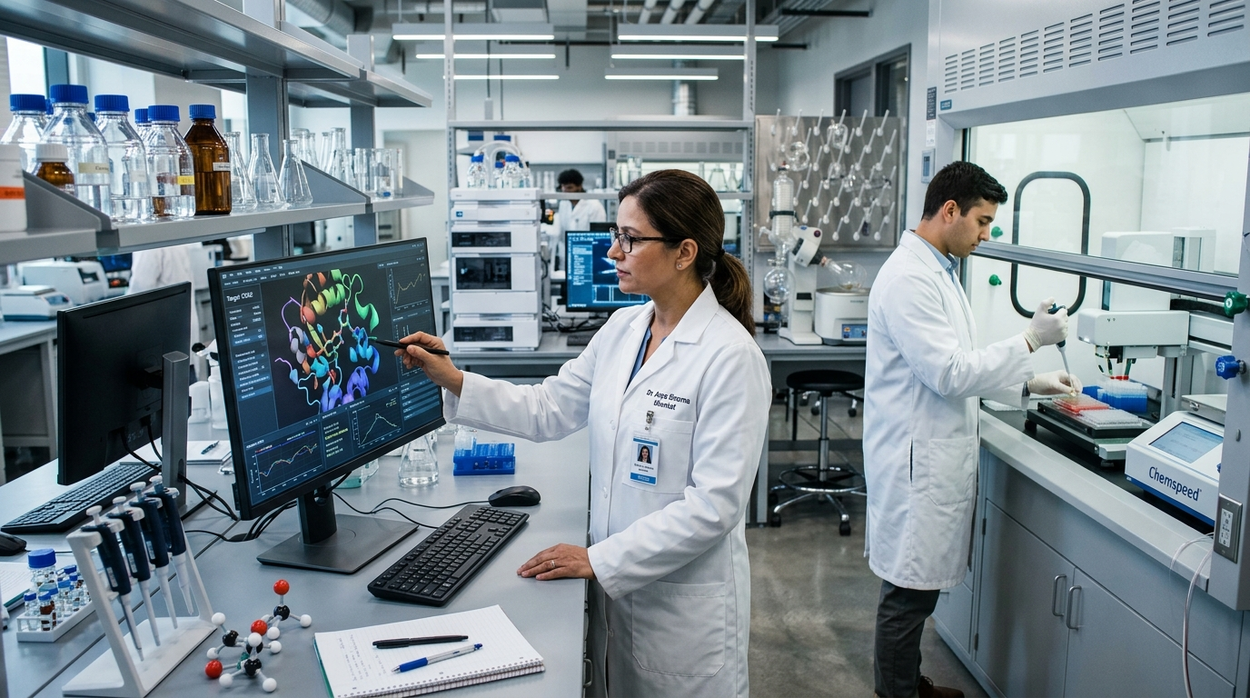
One emerging model is the “self-driving lab.” In such workflows, machine learning systems propose experiments, automated instruments perform selected assays or synthesis steps, experimental results are captured digitally, and the resulting data are fed back into the model. The cycle can then be repeated, allowing the system to prioritize the next experiment based on what has already been learned.
This approach can reduce wasted experimental capacity, particularly when researchers face enormous chemical search spaces. Active-learning strategies are already being explored as a way of improving models iteratively during screening rather than relying entirely on static training datasets.
Successful implementation, however, requires more than software. Data scientists, computational biologists, medicinal chemists, automation specialists, and laboratory scientists need shared workflows and common definitions of success. Laboratory information systems, assay platforms, analytical instruments, and computational infrastructure must also communicate reliably.
The practical shift is from “AI versus traditional discovery” to a continuous computational-experimental feedback loop.
Intellectual Property, Regulatory Compliance, and Ethical Hurdles
AI introduces another layer of complexity around ownership, accountability, data governance, and regulatory credibility.
Patent inventorship is one example. In the United States, the USPTO’s November 2025 revised guidance states that the existing legal standard for inventorship applies whether or not AI was used and that only natural persons can be named as inventors. AI systems are treated as tools used by human inventors.
For pharmaceutical organizations, this makes documentation of human contributions particularly important when AI participates heavily in molecular design. Teams should maintain appropriate records showing how scientists selected targets, defined design objectives, evaluated generated molecules, and contributed to the resulting invention.
Regulatory expectations are evolving as well. The FDA’s January 2025 draft guidance proposes a risk-based credibility framework for AI models used to support regulatory decisions concerning the safety, effectiveness, or quality of drugs and biological products.
The FDA and EMA have also emphasized principles such as context of use, data governance, multidisciplinary expertise, performance assessment, lifecycle management, and human oversight.
For patient-derived datasets, privacy, consent, security, and appropriate governance add further requirements. An AI system may be technically impressive but still unsuitable for pharmaceutical use if its data provenance and compliance controls cannot be demonstrated.
Practical Considerations for Adopting AI Platforms in Research Labs
For biotech and pharmaceutical teams evaluating an AI platform, technical performance should be only one part of the assessment.
A practical checklist
- Data infrastructure: Are internal datasets standardized, well annotated, traceable, and structured for machine learning? Poor data pipelines can undermine an otherwise sophisticated model.
- Model transparency: Can researchers understand why a model selected a target or molecule? Explainability does not have to mean complete visibility into every mathematical operation, but useful evidence and uncertainty estimates should be available.
- Compute scalability: Does the organization have sufficient cloud or on-premise high-performance computing capacity for model training, inference, molecular simulation, and data storage?
- Integration capability: Can the platform connect with existing LIMS, electronic laboratory notebooks, assay systems, compound-management systems, and data warehouses?
- Validation strategy: Has the vendor demonstrated prospective performance rather than relying only on retrospective benchmark scores?
- Governance: Are data access, model versioning, audit trails, security, and lifecycle controls clearly defined?
The most useful AI platform is therefore not necessarily the one with the most sophisticated model. It is the one that can be reliably integrated into the scientific process and evaluated against clearly defined research outcomes.
Evaluating AI Platform Potential: An Example Framework
Organizations selecting an AI drug discovery partner can translate these requirements into a weighted evaluation matrix.
| Evaluation criterion | Example weighting |
| Validation history and track record | 25% |
| Data quality and training corpus depth | 20% |
| Interpretability and explainable AI outputs | 20% |
| Integration with wet-lab workflows | 20% |
| Cost and compute efficiency | 15% |
Validation history and track record receives the highest weighting because prospective evidence is more informative than impressive demonstrations on historical datasets. A platform should be assessed against the specific discovery task it claims to support.
Data quality and training corpus depth matter because the breadth, provenance, and relevance of training data influence model performance.
Interpretability becomes particularly important when scientists need to understand molecular recommendations, identify uncertainty, or justify decisions internally.
Wet-lab integration determines whether computational predictions can be converted efficiently into experiments.
Finally, cost and compute efficiency should include more than the initial software license. Cloud inference, model retraining, storage, data transfer, implementation, and specialist personnel can materially affect total cost.
These weightings should be adjusted according to the organization’s objective. A target-identification program may prioritize biological data and validation, while a molecular-design program may place greater emphasis on chemical-space coverage and experimental integration.
Common Pitfalls and Red Flags to Watch For
AI drug discovery platforms can appear highly capable during demonstrations. Research teams should therefore examine what sits behind the headline claims.
Several warning signs deserve particular attention:
- Marketing claims without prospective validation: Strong benchmark results do not necessarily demonstrate successful drug discovery in real-world settings.
- Opaque or outdated training data: A vendor should be able to explain, at an appropriate level, the provenance and relevance of its training corpus.
- Weak interpretability: If researchers cannot understand the evidence behind a molecular recommendation, validating and challenging the prediction becomes more difficult.
- Poor synthesis awareness: A computationally attractive molecule may be impractical or expensive to manufacture.
- Hidden computational costs: Continuous model training, high-volume inference, cloud storage, and molecular simulation can substantially increase operating expenses.
- Benchmark leakage or unrealistic testing: Models can appear stronger when training and test datasets are not sufficiently independent.
- Limited prospective evidence: One of the strongest questions to ask is whether the platform has successfully predicted experimentally confirmed outcomes on genuinely new data.
The underlying issue is not whether an AI system is powerful. It is whether its performance remains useful when moved from a controlled benchmark into the unpredictable environment of pharmaceutical research.
Final Thoughts — Pragmatic Evolution Over Hype
AI-driven drug discovery has moved beyond the purely speculative stage. Protein structure prediction, generative molecular design, biomarker analysis, and AI-assisted clinical workflows are producing meaningful scientific results, including experimentally validated examples.
But AI is not a mechanism for eliminating biological uncertainty. Models depend on the quality of their data, can struggle outside their training distribution, and cannot replace laboratory and clinical validation.
The most credible path forward is therefore pragmatic. Pharmaceutical and biotech organizations that combine machine learning with high-quality datasets, rigorous experimental testing, multidisciplinary expertise, and appropriate regulatory controls are better positioned to turn computational predictions into useful scientific decisions. AI’s role is not to remove the complexity of drug discovery, but to help researchers navigate that complexity more efficiently.